
Ujian Akhir Semester (UAS) menjadi salah satu tolok ukur keberhasilan pembelajaran siswa selama satu semester penuh. Bagi siswa Kelas 4 Sekolah Dasar, mata pelajaran Bahasa Inggris seringkali menjadi tantangan tersendiri. Namun, dengan persiapan yang matang dan pemahaman yang baik terhadap materi yang akan diujikan, rasa cemas dapat diminimalisir dan digantikan dengan kepercayaan diri.
Artikel ini hadir untuk membantu Anda, baik sebagai siswa, orang tua, maupun pendidik, dalam mempersiapkan diri menghadapi UAS Bahasa Inggris Kelas 4 Semester 2. Kita akan mengulas secara mendalam materi-materi yang umum diujikan, serta menyajikan berbagai contoh soal yang bervariasi, lengkap dengan penjelasannya.
Mengapa Bahasa Inggris Penting di Tingkat Dasar?
Di era globalisasi ini, kemampuan berbahasa Inggris bukan lagi sekadar nilai tambah, melainkan sebuah kebutuhan. Memperkenalkan Bahasa Inggris sejak dini, seperti di jenjang Sekolah Dasar, memiliki banyak manfaat:
- Membuka Gerbang Pengetahuan: Banyak sumber informasi, buku, dan media pembelajaran yang menggunakan Bahasa Inggris. Kemampuan ini akan memudahkan siswa mengakses berbagai pengetahuan.
- Meningkatkan Kemampuan Kognitif: Belajar bahasa baru terbukti merangsang perkembangan otak, meningkatkan daya ingat, kemampuan memecahkan masalah, dan kreativitas.
- Mempersiapkan Masa Depan: Kemampuan berbahasa Inggris adalah aset berharga untuk pendidikan lanjutan dan karir di masa depan.
- Membentuk Kepercayaan Diri: Menguasai keterampilan baru, termasuk berbahasa asing, dapat meningkatkan rasa percaya diri anak.
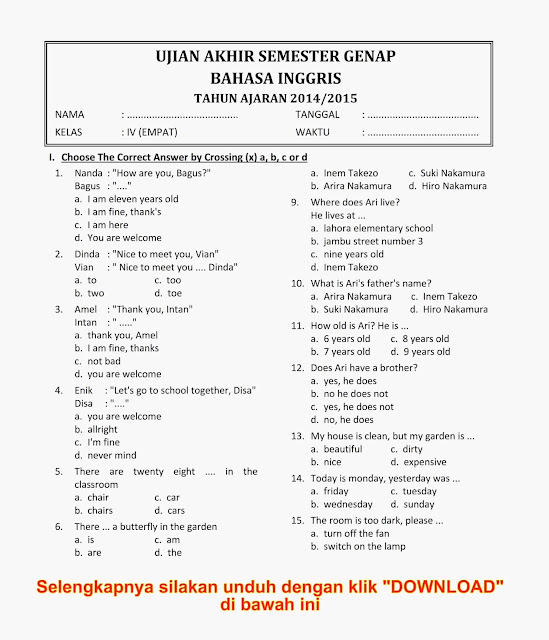
Materi-Materi yang Umum Diujikan dalam UAS Bahasa Inggris Kelas 4 Semester 2
Pada umumnya, materi yang diujikan dalam UAS Bahasa Inggris Kelas 4 Semester 2 akan mencakup topik-topik yang telah dipelajari sepanjang semester. Materi-materi ini biasanya berfokus pada pengenalan kosakata, pemahaman kalimat sederhana, serta kemampuan dasar dalam membaca dan menulis. Berikut adalah beberapa topik utama yang perlu Anda perhatikan:
-
Vocabulary (Kosakata):
- Animals: Berbagai jenis hewan (domestic, wild, farm animals).
- Food and Drinks: Nama-nama makanan dan minuman yang umum.
- Colors: Nama-nama warna.
- Numbers: Angka 1-100.
- Days of the Week & Months of the Year: Hari-hari dalam seminggu dan bulan-bulan dalam setahun.
- Body Parts: Bagian-bagian tubuh.
- Objects in the Classroom/House: Benda-benda di kelas atau rumah.
- Actions/Verbs: Kata kerja dasar (run, jump, eat, drink, read, write, play).
- Adjectives: Kata sifat sederhana (big, small, long, short, happy, sad, beautiful).
-
Grammar (Tata Bahasa) Sederhana:
- Subject-Verb Agreement: Penggunaan kata kerja yang sesuai dengan subjek (misalnya, I play, he plays).
- Singular and Plural Nouns: Bentuk tunggal dan jamak dari kata benda (cat – cats, book – books).
- Articles (a, an, the): Penggunaan artikel yang tepat.
- Prepositions of Place (in, on, under, beside): Kata depan yang menunjukkan lokasi.
- Demonstrative Pronouns (this, that, these, those): Kata ganti penunjuk.
- Simple Present Tense: Digunakan untuk menyatakan kebiasaan, fakta umum, atau kejadian yang berulang.
- Possessive Adjectives (my, your, his, her, its, our, their): Kata sifat kepemilikan.
-
Reading Comprehension (Pemahaman Membaca):
- Memahami teks pendek dan sederhana mengenai topik-topik yang familiar.
- Menjawab pertanyaan berdasarkan informasi yang ada dalam teks.
- Mengidentifikasi informasi spesifik (siapa, apa, di mana, kapan).
-
Writing (Menulis):
- Menulis kalimat sederhana berdasarkan gambar atau instruksi.
- Mengisi rumpang pada kalimat.
- Menyusun kalimat sederhana menjadi paragraf pendek.
Contoh Soal UAS Bahasa Inggris Kelas 4 Semester 2 Beserta Penjelasannya
Berikut adalah berbagai contoh soal yang mencakup materi-materi di atas, disusun agar siswa terbiasa dengan berbagai tipe pertanyaan yang mungkin muncul.
Section 1: Listening Comprehension (If applicable, often done orally by the teacher)
- Note: This section typically requires the teacher to read aloud sentences or short dialogues. Since this is a written format, we will skip the direct listening questions and focus on other sections.
Section 2: Vocabulary
A. Choose the correct answer! (Pilihlah jawaban yang tepat!)
-
What do we call the animal that says "meow"?
a. Dog
b. Cat
c. Bird
d. Fish
Explanation: The question asks for the animal that makes the sound "meow". Cats are known to make this sound. -
Which color is the sky on a sunny day?
a. Green
b. Red
c. Blue
d. Yellow
Explanation: The sky is typically blue on a sunny day. Students should know common color associations. -
I have two ____. They help me to see.
a. Ears
b. Nose
c. Eyes
d. Mouth
Explanation: The sentence describes body parts used for seeing. Eyes are the correct answer. -
Which number comes after twenty-five?
a. Twenty-four
b. Twenty-six
c. Thirty
d. Twenty
Explanation: This tests knowledge of number sequencing. Twenty-six follows twenty-five. -
We eat ____ for breakfast, lunch, and dinner.
a. Air
b. Water
c. Food
d. Light
Explanation: Food is the general term for what we consume for meals. -
What is the opposite of "big"?
a. Large
b. Tall
c. Small
d. Huge
Explanation: This question tests understanding of antonyms. Small is the opposite of big. -
Which of these is a fruit?
a. Carrot
b. Potato
c. Apple
d. Broccoli
Explanation: Students need to identify common fruits from a list of vegetables. -
The elephant is a ____ animal.
a. Small
b. Tiny
c. Big
d. Little
Explanation: Elephants are known for their large size. -
I use a ____ to write on paper.
a. Book
b. Pencil
c. Chair
d. Window
Explanation: A pencil is the tool used for writing. -
What day comes after Sunday?
a. Saturday
b. Monday
c. Friday
d. Wednesday
Explanation: This tests knowledge of the days of the week sequence.
B. Match the words with their pictures! (Pasangkan kata-kata dengan gambarnya!)
(Note: In a real exam, pictures would be provided. Here, we will describe the pictures.)
- A picture of a dog barking.
- A picture of a glass of milk.
- A picture of a yellow banana.
- A picture of a red apple.
- A picture of a table.
Words:
a. Table
b. Milk
c. Dog
d. Banana
e. Apple
- Answer Key: 1-c, 2-b, 3-d, 4-e, 5-a
Explanation: This section tests visual recognition and association of words with objects/concepts.
Section 3: Grammar
A. Fill in the blanks with the correct word! (Isilah bagian yang kosong dengan kata yang tepat!)
-
I __ (play/plays) football every Saturday.
Explanation: The subject is "I" (first person singular), so the verb should be in its base form: "play". -
She __ (go/goes) to school by bus.
Explanation: The subject is "She" (third person singular), so the verb needs an "-s" ending: "goes". -
There are three __ (book/books) on the table.
Explanation: The number "three" indicates more than one, so we use the plural form of "book": "books". -
This is __ (a/an) orange.
Explanation: The word "orange" starts with a vowel sound, so we use the article "an". -
He is sitting __ the chair.
a. on
b. in
c. under
d. beside
Explanation: People typically sit "on" a chair. -
The cat is sleeping __ the bed.
a. on
b. in
c. under
d. beside
Explanation: The cat is likely on top of the bed. -
__ is my favorite color.
a. This
b. That
c. These
d. Those
Explanation: The sentence is talking about one specific color, so "This" is appropriate. -
__ are my new shoes.
a. This
b. That
c. These
d. Those
Explanation: "Shoes" is plural, and "These" or "Those" can be used. Assuming the shoes are near the speaker, "These" is a good choice. If they are further away, "Those" would also be correct. For a 4th grader, "These" is often introduced first for nearby plurals. -
My mother __ (cook/cooks) dinner every evening.
Explanation: The subject is "My mother" (third person singular), so the verb needs an "-s" ending: "cooks". -
We __ (eat/eats) lunch at 12 o’clock.
Explanation: The subject is "We" (first person plural), so the verb should be in its base form: "eat".
B. Put the words in the correct order to make a sentence! (Susun kata-kata berikut menjadi kalimat yang benar!)
-
is / a / This / pen / red / .
Answer: This is a red pen.
Explanation: This tests sentence structure (Subject + Verb + Object/Complement). -
likes / He / ice cream / .
Answer: He likes ice cream.
Explanation: Subject + Verb + Object. -
play / We / in / the / park / .
Answer: We play in the park.
Explanation: Subject + Verb + Prepositional Phrase. -
are / These / books / new / .
Answer: These are new books.
Explanation: Demonstrative Pronoun + Verb + Adjective + Noun. -
go / They / to / school / to / .
Answer: They go to school.
Explanation: Subject + Verb + Prepositional Phrase.
Section 4: Reading Comprehension
Read the text below and answer the questions! (Bacalah teks di bawah ini dan jawablah pertanyaan-pertanyaan!)
My name is Budi. I am eight years old. I have a dog. Its name is Brownie. Brownie is a small dog. He likes to play with a ball. I often play with Brownie in the garden. My mother gives Brownie food and water every day. Brownie is a good dog.
Questions:
-
What is the boy’s name?
a. Brownie
b. Budi
c. Dog
d. Garden
Answer: b. Budi
Explanation: The first sentence states "My name is Budi." -
How old is Budi?
a. Seven years old
b. Eight years old
c. Nine years old
d. Ten years old
Answer: b. Eight years old
Explanation: The second sentence states "I am eight years old." -
What pet does Budi have?
a. A cat
b. A bird
c. A dog
d. A rabbit
Answer: c. A dog
Explanation: The third sentence states "I have a dog." -
What is the dog’s name?
a. Budi
b. Doggy
c. Brownie
d. Spot
Answer: c. Brownie
Explanation: The fourth sentence states "Its name is Brownie." -
What does Brownie like to play with?
a. A bone
b. A stick
c. A toy car
d. A ball
Answer: d. A ball
Explanation: The fifth sentence states "He likes to play with a ball." -
Where does Budi often play with Brownie?
a. In the house
b. In the park
c. In the garden
d. In the street
Answer: c. In the garden
Explanation: The sixth sentence states "I often play with Brownie in the garden." -
Who gives Brownie food and water?
a. Budi
b. Father
c. Sister
d. Mother
Answer: d. Mother
Explanation: The seventh sentence states "My mother gives Brownie food and water." -
Is Brownie a big dog?
a. Yes, he is.
b. No, he isn’t.
c. Yes, he is a big dog.
d. No, he is a small dog.
Answer: d. No, he is a small dog.
Explanation: The fourth sentence states "Brownie is a small dog."
Section 5: Writing
A. Write a sentence for each picture! (Tulislah satu kalimat untuk setiap gambar!)
(Note: Again, pictures would be provided. We’ll describe them.)
-
Picture: A girl eating an apple.
Sentence: The girl is eating an apple. -
Picture: A cat sleeping on a mat.
Sentence: The cat is sleeping on the mat. -
Picture: A boy riding a bicycle.
Sentence: The boy is riding a bicycle.
B. Complete the sentences! (Lengkapi kalimat-kalimat berikut!)
-
My favorite color is ____. (e.g., blue)
Explanation: Students should fill in their favorite color. -
I can ____. (e.g., run)
Explanation: Students should write a verb describing an action they can do. -
There are ____ days in a week.
Answer: seven
Explanation: Tests knowledge of the number of days in a week. -
A ____ says "moo".
Answer: cow
Explanation: Tests knowledge of animal sounds and names. -
I go to school by ____. (e.g., bus, car, bicycle)
Explanation: Students should fill in their mode of transportation to school.
C. Write five sentences about your favorite animal! (Tulislah lima kalimat tentang hewan favoritmu!)
- (Example Answer for a student who likes cats):
- My favorite animal is a cat.
- Cats are cute.
- My cat is black and white.
- It likes to play with a ball.
- I love my cat.
Explanation: This section assesses the ability to form simple sentences and express personal preferences about a topic.
Tips Sukses Menghadapi UAS Bahasa Inggris:
- Ulangi Materi Secara Berkala: Jangan menunda belajar hingga mendekati hari ujian. Ulangi kosakata dan tata bahasa yang telah dipelajari secara rutin.
- Perbanyak Latihan Kosakata: Gunakan flashcards, aplikasi belajar bahasa, atau membuat daftar kosakata baru setiap hari. Hafalkan arti dan cara pengucapannya.
- Pahami Konsep Tata Bahasa Sederhana: Fokus pada pemahaman penggunaan "a/an", bentuk jamak, simple present tense, dan preposisi. Latihan membuat kalimat sederhana.
- Latihan Membaca Teks Pendek: Bacalah cerita-cerita pendek atau teks informatif sederhana dalam Bahasa Inggris. Cobalah menjawab pertanyaan berdasarkan teks tersebut.
- Minta Bantuan: Jika ada materi yang sulit dipahami, jangan ragu bertanya kepada guru, orang tua, atau teman.
- Istirahat yang Cukup: Pastikan tidur yang cukup sebelum hari ujian agar pikiran tetap segar.
- Tetap Tenang dan Percaya Diri: Hadapi ujian dengan tenang. Baca setiap soal dengan teliti sebelum menjawab. Ingatlah bahwa Anda telah berusaha keras.
Peran Orang Tua dalam Mendampingi Belajar:
Orang tua memegang peranan penting dalam mendukung keberhasilan anak belajar Bahasa Inggris. Beberapa cara yang bisa dilakukan:
- Ciptakan Lingkungan yang Mendukung: Sediakan buku-buku cerita berbahasa Inggris yang sesuai usia, putarkan lagu anak-anak berbahasa Inggris, atau tonton kartun edukatif berbahasa Inggris bersama.
- Latihan Percakapan Sederhana: Ajak anak berbicara menggunakan frasa-frasa sederhana dalam Bahasa Inggris, seperti menyapa, bertanya kabar, atau menyebutkan nama benda.
- Gunakan Permainan Edukatif: Banyak permainan yang dapat membantu anak belajar kosakata dan tata bahasa Bahasa Inggris dengan cara yang menyenangkan.
- Berikan Apresiasi: Berikan pujian dan dorongan ketika anak berhasil mempelajari sesuatu yang baru atau menjawab pertanyaan dengan benar. Ini akan meningkatkan motivasi mereka.
- Pantau Kemajuan Belajar: Perhatikan materi yang dikuasai anak dan area mana yang masih perlu ditingkatkan.
Penutup
UAS Bahasa Inggris Kelas 4 Semester 2 bukan hanya sekadar ujian, tetapi juga merupakan kesempatan bagi siswa untuk menunjukkan pemahaman mereka terhadap materi yang telah diajarkan. Dengan persiapan yang terarah, latihan yang konsisten, dan dukungan dari lingkungan sekitar, siswa Kelas 4 dapat menghadapi ujian ini dengan percaya diri dan meraih hasil yang memuaskan.
Semoga artikel ini dapat menjadi panduan yang bermanfaat dalam mempersiapkan diri menghadapi UAS Bahasa Inggris. Selamat belajar dan semoga sukses!